
The digital world is changing fast. Artificial intelligence and blockchain are coming together. This mix is set to change many industries, make things safer, and bring new levels of smartness.
People are really excited about this. The market has grown a lot, with some AI-powered coins now worth over $1 billion. Experts think this growth will keep going as these technologies blend more.
This is a great time for investors and tech fans. The mix of smart algorithms and blockchain changes everything. It opens up new ways to make contracts, improve networks, and create new economic systems.
That broader market context also helps when evaluating ai crypto agents and, especially where AI, automation, and speculation start to overlap.
Knowing which projects are leading the way is key. We’ll look at the top players in blockchain AI innovation. They’re the ones making this exciting mix happen.
The Synergy Between Artificial Intelligence and Blockchain
The true power of AI crypto comes from combining decentralised networks with intelligent algorithms. This mix creates a digital world that’s more capable and independent. It goes beyond what each technology can do alone.
Blockchain technology is key for trust, thanks to its decentralised and open ledger. It helps solve big challenges in AI development. For example, it makes data markets fair and open. Data providers get paid directly, and AI developers get diverse data to train better models.
Artificial intelligence adds smart thinking to blockchain systems. AI algorithms can spot patterns in data that humans can’t. This leads to smarter automation and more dynamic smart contracts.
This partnership works in two main ways:
- Blockchain Empowering AI: It provides a safe, open space for decentralised AI to grow. This includes sharing data and computing power. People can help train big AI models with their spare computing power.
- AI Optimising Blockchain: Smart systems make networks safer by catching fraud quickly. They also make things run smoother and personalise user experiences. This is making Web3 smarter and more efficient.
This mix drives the most exciting machine learning crypto projects. They’re building a world where AI and finance work together. Creators can make money from data safely, and digital economies can run almost on their own. This leads to a future where blockchain is not just a ledger, but a smart platform that learns and adapts.
Grasping this core synergy is key. It’s what makes these projects so promising and ambitious. The next sections will look at how these ideas are becoming real.
Analysing the Investment Poteial of AI Cryptocurrencies
Looking at AI crypto assets, we see two main things. First, their cutting-edge tech and second, their unpredictable market. The sector’s ups and downs show the power of real innovation and the impact of speculation.
Recent data shows how volatile the market is. By December 2025, top AI tokens saw huge growth, grabbing the world’s attention. But then, prices dropped sharply. This shows the market is finding its balance, with prices changing fast due to news and trends.
Many predict growth in 2026 and later. They point to AI’s growing use in real life, like in autonomous systems and secure data markets. But, experts say real progress comes from actual tech advancements.
The success of AI crypto projects depends on solving big problems and showing real value.
Investing in AI crypto is not just about making money fast. It’s about understanding the real value behind it. This means looking at more than just prices.
Investors should check a project’s tech plan, how its protocol is adopted, and its ecosystem’s activity. While market size and volume are important, the true investment thesis is about usefulness and network effects.
A smart crypto investment strategy sees AI crypto as a high-risk, high-reward part of a diverse portfolio. It’s about believing in the tech and the team, not just following the trend. This careful approach helps manage risk and aims for long-term growth as AI tech improves.
In short, the investment chance is huge but needs careful consideration. Success goes to those who back projects with real AI infrastructure, not just fleeting excitement.
Essential Criteria for Evaluating AI Crypto Projects
To spot a real project from just hype, you need to do your homework. This means looking at specific, measurable things. AI and blockchain together offer new investment chances, but they need careful checking.
Don’t just look at prices and hype. A good check-up looks at what really matters for lasting value and a strong network.
Core Technology and Real-World Application
The heart of any good project is its tech. Check if the AI tech is new and can grow. See if it solves a real problem.
A clear use case is key. The tech should meet a real need, like better data sharing or smart agent systems. Projects with working products are more believable than those with just ideas.
Team Expertise and Strategic Backing
The team behind a project is very important. Look at their skills in AI, coding, and software. A history of success in similar areas is a good sign.
Also, check who supports the project. Big investors and partners mean more than just money. They show the project has been checked and approved.
A project’s tokenomics is its economic heart. It’s not just about how many tokens there are. See how the token works in the network. Is it for paying for services, securing the network, or updating the system?
It’s important to understand the economic plan. Look at how tokens are given out, inflation rates, and how value is added. Good tokenomics makes sure everyone involved benefits, keeping the network healthy.
Competitive Moat and Market Traction
Know where the project stands in the market. Does it have something special, like a unique tech or partnerships? This “moat” helps it keep its place in the market.
Lastly, check if the project is doing well in real life. Look at GitHub activity, network volume, partnerships, and user growth. Success shows the project’s business model works.
| Evaluation Pillar | Key Questions to Ask | Why It Matters |
|---|---|---|
| Technology & Use Case | Is the AI technology unique and scalable? What specific problem does it solve? Is there a live product or testnet? | Determines the project’s fundamental value proposition and its adoption chances. |
| Team & Backing | Do founders have relevant expertise? Which reputable VCs or corporations are invested? Is there an active, skilled development community? | Shows the project’s ability to carry out its plans and face challenges. |
| Tokenomics & Utility | What is the token’s specific role in the network? How is value captured and distributed? Is the emission schedule sustainable? | Defines the economic incentives and long-term viability of the token’s value. |
| Competitive Position | What is the project’s unique advantage? How does it compare to direct competitors? Is the market size growing? | Assesses the project’s ability to capture and retain market share over time. |
| Market Traction | What are the key growth metrics (users, transactions, TVL)? Is developer activity increasing? Are new partnerships being announced? | Provides evidence of real-world adoption and validation of the business model. |
Using this structured way to check projects turns guessing into smart analysis. By looking at the tech, team, tokenomics, competitive edge, and real-world success, you get a full picture. This careful checking is your best tool for finding AI crypto projects with real promise.
The Top 5 AI Crypto Projects to Watch Right Now
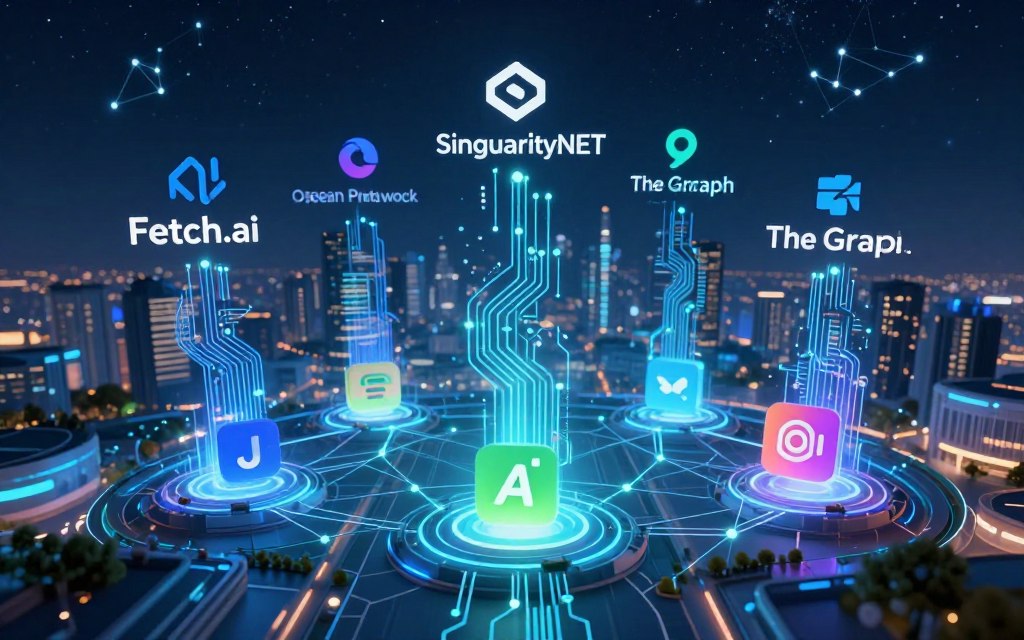
This section looks at five AI cryptocurrency projects that stand out. They show how to mix machine intelligence with decentralised networks in new ways. These projects, including some of the best AI cryptocurrencies to buy, are chosen for their tech, real-world use, and growth chances. We’ll dive into each project’s main goals, key features, why to invest, and risks.
1. Fetch.ai (FET)
Project Overview
Fetch.ai wants to create a network where machines can work together without humans. It aims to build a digital world where agents can trade and collaborate freely.
The project focuses on finance, supply chains, and the Internet of Things (IoT). The FET token is used to power all activities in this ecosystem.
Core Technology & Key Features
Fetch.ai’s core is its framework for Autonomous Economic Agents (AEAs). These smart programs act on behalf of users, companies, or devices.
Key features include:
- Agent Communication: AEAs can find each other, negotiate, and trade using the FET token.
- Open Economic Framework: The network gives tools for developers to build agent-based apps quickly.
- Collective Learning: Agents can share and benefit from machine learning models while keeping data private.
Investment Thesis & Potencial
The case for investing in Fetch.ai is based on its agent network. As more AEAs join, the network’s value grows for everyone.
Potential growth areas include automating DeFi, optimising logistics, and managing smart grids. If it succeeds in creating a decentralised digital economy, Fetch.ai could become key infrastructure.
Risks & Considerations
The main challenge is the technical complexity. This might slow down developer adoption. The project also faces competition from other platforms aiming to automate web services.
The value of the FET token is affected by market cycles and shifts in AI crypto sentiment.
2. SingularityNET (AGIX)
Project Overview
SingularityNET aims to create a marketplace for AI services. Its goal is to help develop Artificial General Intelligence (AGI) with human-like abilities.
The platform lets AI developers share and monetise their tools. Users can access a wide range of AI services using the AGIX token.
Core Technology & Key Features
The platform makes it easy for different AI services to work together. Complex tasks can be done by combining several AI tools from various providers.
Its architecture is open and permissionless. This encourages collaboration and prevents big corporations from dominating advanced AI.
Investment Thesis & Potencial
SingularityNET is at the crossroads of blockchain and AGI. Its marketplace model could make powerful AI more accessible.
Analysts see it as a low-risk investment due to its established platform and roadmap. Strategic partnerships and ethical AI development add to its long-term promise.
Risks & Considerations
The main risk is the speculative and long-term nature of AGI. Success is uncertain and may take decades.
The platform must attract top AI researchers and developers. It faces competition from well-funded centralised alternatives.
3. Ocean Protocol (OCEAN)
Project Overview
Ocean Protocol is a decentralised data exchange. It helps individuals and organisations share and monetise data while keeping privacy and control.
The protocol acts as a bridge between data providers and consumers. It’s powered by the OCEAN token in a secure, transparent marketplace.
Core Technology & Key Features
Ocean’s innovation is its use of “data tokens.” These tokens represent the right to access specific datasets or services.
Compute-to-Data is a key feature. It allows algorithms to be sent to data locations for analysis, preserving privacy and complying with regulations.
Investment Thesis & Potencial
Data is key for AI. Ocean Protocol provides the infrastructure for a new data economy where information can be traded as an asset.
Its growth is tied to the AI industry’s expansion and the value of proprietary datasets. By solving data access and privacy issues, it’s seen as critical middleware for AI.
Risks & Considerations
Adoption by large enterprises with valuable data is slow. The protocol operates in a regulatory grey area concerning data ownership and transfer.
It faces competition from other data-centric blockchain projects and traditional data marketplaces.
4. The Graph (GRT)
Project Overview
The Graph is like the “Google of blockchains.” It indexes and queries data from networks like Ethereum and Polygon.
This service is vital for dApps, including many AI-powered ones, that need efficient access to on-chain information. The GRT token secures the network and rewards participants.
Core Technology & Key Features
Developers build APIs called “subgraphs” to organise blockchain data. dApps query these subgraphs using GraphQL for quick and reliable data access.
The network is maintained by a decentralised community of Indexers, Curators, and Delegators. They stake GRT tokens to perform their roles and earn rewards.
Investment Thesis & Potencial
The Graph’s value lies in its foundational role. As Web3 grows, so does the need for efficient data querying.
Any AI app needing to analyse or react to on-chain events will rely on The Graph. Its first-mover advantage and widespread integration among major dApps create a strong competitive edge.
Risks & Considerations
The project’s success depends on the growth and activity of the broader blockchain dApp ecosystem. A slowdown in dApp development would impact demand.
There are also technical governance challenges in maintaining a truly decentralised and censorship-resistant indexing network at scale.
5. Render Network (RNDR)
Project Overview
Render Network is a decentralised platform for GPU rendering. It connects artists and studios needing high-performance computing with individuals and facilities with spare GPU power.
Users pay for rendering jobs with the RNDR token. Node operators earn tokens for contributing their computational resources.
Core Technology & Key Features
The network distributes complex rendering tasks across a global pool of GPUs. This is faster and often cheaper than using a single machine or a centralised cloud service.
It uses a proof-of-render system to verify work completion before releasing payment. The platform supports major tools like Blender, Cinema 4D, and Unreal Engine.
Investment Thesis & Potencial
The demand for GPU compute is growing, driven by rendering and AI model training. Render Network offers a scalable, distributed alternative to centralised providers.
Its use case extends beyond media into scientific simulation, machine learning, and generative AI art. By monetising idle GPU power globally, it taps into a vast, underutilised resource.
Risks & Considerations
The network faces competition from tech giants like Nvidia, which offers its own cloud rendering and AI platforms. Ensuring consistent quality, reliability, and speed across a decentralised network is a challenge.
The value of the RNDR token is sensitive to supply and demand dynamics for GPU compute cycles.
| Project | Primary Focus | Core Token Utility | Key Advantage | Main Risk Factor |
|---|---|---|---|---|
| Fetch.ai (FET) | Autonomous Economic Agents | Powering agent transactions & network fees | Pioneering decentralised automation for complex systems | High technical complexity for widespread adoption |
| SingularityNET (AGIX) | AI Services Marketplace & AGI | Accessing & monetising AI services on the platform | Democratising access to advanced AI and fostering AGI development | Speculative, long-term nature of the AGI mission |
| Ocean Protocol (OCEAN) | Decentralised Data Exchange | Purchasing data access & governing data marketplaces | Unlocking private data for AI while preserving privacy (Compute-to-Data) | Slow enterprise adoption and evolving data regulations |
| The Graph (GRT) | Blockchain Data Indexing | Securing the network & incentivising indexers/curators | Essential querying infrastructure for the entire Web3 ecosystem | Dependent on overall growth of dApp activity |
| Render Network (RNDR) | Distributed GPU Computing | Paying for rendering/compute jobs & rewarding node operators | Leverages a global, underutilised resource of GPU power | Competition from centralised cloud computing giants |
The Critical Role of Tokenomics in AI Projects
Tokenomics is key to understanding a cryptocurrency’s economic model. It’s as important as the AI technology itself. Investors need to look at a project’s tokenomics as much as its AI algorithms.
Good token economics do three main things. They encourage people to join the network by giving them tokens. They also help decide how the network changes through voting. And they make sure the token’s value grows with the network.
Each AI project has its own way of using tokens. Some tokens are used to buy services. Others are needed to do specific tasks. Knowing how tokens are used helps figure out if a project will last.
The Graph (GRT) is a good example of a work token. People need to stake GRT to help the network. This way, they get rewarded in GRT for their work. It makes sure the network works well.
Render Network (RNDR) is different. It uses tokens to pay for services. Artists use RNDR to get GPU power from others. This makes the token’s value depend on how much people need GPU power.
Bittensor (TAO) rewards people for contributing resources. TAO is given to those who train and share AI models. This encourages making good AI. The reward is directly linked to the network’s growth.
| Token Utility Model | Primary Function | Example Project |
|---|---|---|
| Work Token | Required to be staked or locked to perform network work and earn fees. | The Graph (GRT), Fetch.ai (FET) |
| Medium of Exchange | Used as the primary currency to pay for network goods and services. | Render Network (RNDR), Ocean Protocol (OCEAN) |
| Governance & Staking | Enables voting rights and provides security/stability through staking rewards. | SingularityNET (AGIX), many DeAI projects |
When checking out an AI crypto project, look at its tokenomics. It should have clear ways to reward people, decide on changes, and grow in value. A good model helps everyone involved. It’s what makes a project succeed in the long run.
Navigating the Regulatory Landscape
Investors and developers in AI crypto face big challenges due to unclear rules. This area blends two fast-changing tech fields, each with its own rules. This mix creates a messy, changing legal scene.
Projects have to deal with three main issues. First, they must follow traditional finance laws. Bodies like the US Securities and Exchange Commission check if a token is a security. If not, they could face big penalties or even shut down.
Second, data privacy laws are a big hurdle. AI needs lots of data to work well. Projects must follow strict rules like the EU’s GDPR or California’s CCPA. Breaking these rules can lead to huge fines and losing user trust.
Lastly, new AI laws are being made. Governments are creating rules for AI, focusing on ethics and being open. Blockchain AI projects must show how they fit into these rules.
The table below shows the main rules, their challenges, and how they affect AI crypto projects.
| Regulatory Domain | Primary Challenge | Implication for AI Crypto Projects |
|---|---|---|
| Financial Securities | Deciding if tokens are securities or not. | Could face legal trouble, need to register, and face sales and trading limits. |
| Data Privacy & Protection | Following laws on personal data use. | Must anonymise data well and get clear user consent in smart contracts. |
| AI Governance & Ethics | Following new rules on AI fairness and openness. | Must check AI for bias and explain how it works. |
Smart projects see rules as a chance to grow, not just a hurdle. They work with lawmakers to make good rules. This shows they’re serious about lasting success. For investors, a project’s approach to rules is as important as its tech plan when looking at which AI crypto projects are likely to do well in the future.
Regulatory risk is key for every investment in this field. A project in a grey area might offer big gains but also big risks. The best chances will be with teams that focus on following rules and being open from the start. They’ll navigate the complex rules with care and planning.
Emerging Trends Shaping the Future of AI on Blockchain
The future of machine learning crypto is being shaped today. It’s guided by trends in infrastructure, autonomy, and privacy. These changes are moving us towards a more integrated, intelligent, and user-focused digital world.
One key trend is the growth of Decentralised Physical Infrastructure Networks (DePIN). These networks aim to create global markets for computing resources like GPU power. This is key for decentralised AI, as it allows for complex model training without relying on cloud providers. It makes high-performance computing more accessible to everyone.
Another trend is the blending of AI with Decentralised Finance (DeFi). This mix is creating advanced tools. AI can now analyse large amounts of data, spotting trends and opportunities. It can also handle automated trading, taking DeFi to a new level of data-driven decision-making.
Thirdly, we’re seeing the rise of truly autonomous AI agents. These are not just simple chatbots but independent digital beings. They can perform tasks, negotiate, and achieve economic goals on their own. Built on decentralised AI platforms, they can manage investments, schedule services, or optimise supply chains.
Lastly, there’s a focus on AI that’s verifiable and respects privacy. New technologies like zero-knowledge proofs and secure multi-party computation allow for AI training on sensitive data without exposing it. This makes decentralised AI training on blockchain possible, where the process is transparent but the data remains private. This addresses big issues of trust and data protection.
These trends of decentralised computing, smart DeFi, autonomous agents, and private machine learning are building a stronger AI sector. They mark a significant step forward for machine learning crypto, moving from promise to practical, useful applications.
Practical Risks and Challenges for the Sector
Before investing in crypto, it’s key to know the risks. Understanding these challenges helps investors make smart choices. It’s about being cautious yet hopeful in this fast-changing field.
The tech itself faces big hurdles. Many AI systems, like complex neural networks, are hard to understand. This makes it hard to match blockchain’s values of openness and checkability. The lack of clear AI explanations is a big obstacle to trust and use.
The competition is fierce. In crypto, many projects fight for money, attention, and talent. Big tech companies like Google and Amazon also compete. They have lots of resources and can create their own AI solutions, which might challenge the crypto model.
Running AI is expensive. It needs lots of computing power and quality data. For a decentralised network, this can be too costly. It might limit the growth and complexity of AI on blockchain compared to centralised systems.

The market is also at risk of being too full and speculative. The excitement around AI can lead to projects that focus more on marketing than real innovation. As one expert says, true progress comes from real innovation, not just hype. This can lead to big drops in value, testing how committed investors are.
There are also big ethical questions. Concerns about data privacy, bias in algorithms, and the risk of harm from AI are big debates. How AI crypto projects handle these issues will affect their rules and how people see them. A good crypto investment strategy must look into a project’s ethics and how it’s governed.
In short, combining AI and blockchain is groundbreaking but risky. Investors need to carefully consider the tech’s readiness, the competition, the costs, and the ethics. This careful approach is key to success in this field.
How to Build a Position in AI Cryptocurrencies
Investors looking to benefit from AI and blockchain need a solid plan. It’s not about guessing, but about building a strong, informed investment.
Start by learning as much as you can about AI tokens. This knowledge is key to success. Read trusted sources, whitepapers, and project documents to grasp the problem a blockchain AI project aims to solve.
Research should be thorough. Look at the team’s skills, the project’s tech plan, and its chances of success. This helps spot real opportunities from just hype.
After finding promising projects, here’s how to invest:
- Practise Prudent Portfolio Allocation: Spread your money across different investments. Put only a part of your portfolio in AI cryptocurrency. This way, you can enjoy growth while protecting your money.
- Employ Dollar-Cost Averaging (DCA): Crypto markets can be unpredictable. Invest a fixed amount regularly, no matter the price. This method helps even out your costs over time.
- Prioritise Secure Storage: Move your tokens off exchanges after buying. Use a reliable hardware wallet for big amounts. For smaller amounts, a software wallet is safer and lets you interact with projects.
- Stay Abreast of Technological Developments The blockchain AI world changes fast. Keep up with updates and new partnerships. This info is vital for making smart investment choices.
- Engage with Project Ecosystems: Many projects offer more than just token holding. Look into staking for rewards or voting in governance. This way, you can earn more and learn more about the project.
Building a position is an ongoing journey, not a one-time task. Always check your investments against your original reasons. Be ready to adjust your strategy as the market evolves. With careful research and smart risk management, you can confidently explore the world of AI cryptocurrencies.
Conclusion
Artificial intelligence and blockchain technology are changing networks for the better. This mix makes systems smarter and more efficient. It’s creating a new kind of digital world.
Fetch.ai FET and SingularityNET AGIX are leading the way. They use AI in new ways. Ocean Protocol OCEAN, The Graph GRT, and Render Network RNDR also play big roles. They show how diverse and exciting this field is.
The growth of AI crypto agents is fast. It’s a field that needs careful thought and research. Investors must understand the risks and how it works.
AI and blockchain together will change our digital world. It’s important to think long-term and be ready for this big change.

 By
By