

Artificial intelligence has moved from science fiction to the heart of business. It’s now a big part of every industry. This change has big transformative implications for how we work and compete.
Data from McKinsey shows a huge increase in AI use. About 88% of companies now use AI in key business areas.
This change is huge. Tools like ChatGPT have quickly become essential, not just a new thing.
That broader commercial context becomes clearer when you look at deploy a deep learning model and how teams apply AI in day-to-day operations.
AI is no longer just a way to stay ahead. It’s now a critical business need for any big company.
This big AI business transformation is changing everything. It’s changing how we do our daily work and big strategic decisions. It’s also changing what work means.
It’s key for leaders and workers to understand this workplace automation and its effects on people. The next parts will dive deeper into this new world.
The Pervasive Integration of AI in Modern Organisations
Artificial intelligence is now a real tool, not just a dream. Machine learning and generative AI are its key parts. These technologies are changing how companies work, making them more efficient and innovative.
Understanding Artificial Intelligence and Machine Learning
Artificial Intelligence (AI) means computers that can do things humans do. For businesses, the most important parts are Machine Learning (ML) and Generative AI.
Machine learning applications help computers find patterns in data. They learn from big datasets and make predictions. This is how self-driving cars and fraud detection systems work.
Generative AI is a big step forward. It creates new content like text, images, and code. This is changing the game in creative fields, software, and marketing.
For example, ML helps predict when machines need fixing in factories. Generative tools help developers and marketers by writing code and copy.
The Acceleration of AI Adoption Across Sectors
AI is becoming a must-have for companies fast. Every sector is trying to use AI to stay ahead.
In healthcare, AI helps diagnose images. Banks use it for quick risk checks and trading. Retailers and manufacturers use AI for better pricing and managing stock.
Studies show over half of big companies have AI projects running. They see real benefits like saving money and making more. Even new areas like cryptocurrency are exploring AI.
The table below shows the main AI technologies:
| Technology | Core Function | Key Business Application |
|---|---|---|
| Artificial Intelligence (AI) | Simulating human-like intelligence and problem-solving | Broad strategic automation and cognitive tasks |
| Machine Learning (ML) | Identifying patterns and making predictions from data | Predictive analytics, fraud detection, personalised recommendations |
| Generative AI | Creating original text, code, media, and data | Content creation, software development acceleration, design prototyping |
AI is changing everything. It’s not just a tech project but a key part of business strategy. It’s how companies operate and compete today.
Automating Repetitive Tasks and Operational Workflows
AI is changing how we work by automating boring tasks. This is happening now, not in the future. It’s making businesses more efficient.
Studies show 47% of AI projects focus on making processes better. This is the first step in using AI, and it shows quick results.
Liberating Human Labour from Mundane Activities
Many hours are spent on tasks that are dull but necessary. These include data entry, checking information, and handling invoices. AI is great at these tasks.
AI takes over these jobs, freeing up people to do more important work. It can handle lots of data fast, something humans can’t do.
By doing these tasks, AI helps people do better work. They can solve problems, plan, and think creatively. These are things that need human skills.
The Role of Robotic Process Automation and Intelligent Systems
The key to this change is robotic process automation (RPA) and smart software. RPA are like digital helpers that do tasks on their own.
They can do things like:
- Extracting data from emails and forms to populate databases.
- Reconciling transactions and generating standard reports.
- Moving files between folders and triggering approval workflows.
With AI, these systems get smarter. They can handle more data and make decisions on their own. This makes work smoother.
It’s a smart move for businesses. It saves money, cuts down on mistakes, and makes work faster. This means businesses can make more money.
Using automation is a key way to improve AI and productivity. It makes work flow better, lets people focus on important tasks, and helps businesses stay ahead.
Augmenting Human Decision-Making with Data Insights
AI does more than just automate tasks. It enhances human judgement through deep data analysis. This shift moves from just being efficient to truly empowering. AI decision-making tools boost the power of managers and executives.
These systems look through huge amounts of data. They find patterns and connections that humans can’t see.
This help turns raw data into useful information. Leaders can now plan ahead instead of just reacting. This leads to better, more confident business decisions.
Leveraging Predictive Analytics for Strategic Advantage
Predictive analytics AI is leading this change. It uses machine learning to predict future events. Companies use it to guess what customers will want and when.
For example, a store can use it to manage stock better. This means they avoid running out of items and wasting money on too much stock. It gives them a head start on making money or avoiding problems.
“The use of predictive analytics is a big step forward. It helps us decide what to do next, not just what happened. It’s key for making AI decision-making work today.”
AI is great for complex situations. It can handle lots of information quickly. It doesn’t replace humans but gives them better advice.
AI in Financial Forecasting and Risk Assessment
The finance world shows AI’s power. Old forecasting methods were often wrong. AI looks at market data and financial records to make better forecasts. Studies show AI can cut forecasting errors by 20 to 50 percent.
In risk assessment, AI is a big help. It checks transactions fast and finds fraud signs better than humans. It also looks at more data than old methods to judge credit risk.
AI is also good for following rules and managing budgets. It can review legal papers and AI chatbot legally draft documents for checks. It also suggests changing budgets based on spending and goals.
| Decision Area | Traditional Approach | AI-Augmented Approach | Key Improvement |
|---|---|---|---|
| Sales Forecasting | Manual extrapolation of past sales, often quarterly. | Real-time analysis of market trends, web traffic, and sentiment data. | Increased accuracy and agility in response to market shifts. |
| Risk Assessment | Periodic audits and static financial ratios. | Continuous monitoring of transactions and alternative data for holistic profiling. | Proactive identification of vulnerabilities and fraudulent activity. |
| Fraud Detection | Sample-based checks and rule-based systems. | Pattern recognition across millions of transactions to identify novel fraud schemes. | Dramatically reduced false positives and increased detection rates. |
| Budget Allocation | Fixed annual budgets based on historical departments. | Dynamic models that reallocate funds based on project performance and strategic ROI. | Optimised resource utilisation and alignment with strategic objectives. |
The table shows how AI changes things. AI doesn’t replace finance leaders. It gives them better insights. This makes financial management a key part of strategy.
The main goal of predictive analytics AI is to reduce uncertainty. It gives leaders clear views of the future. This helps them make informed, timely, and strategic decisions.
Revolutionising Customer Service and Engagement
Now, customers expect instant, personalised service. This is no longer just from humans but also from smart algorithms. Artificial intelligence is changing how businesses talk to their clients. It makes things more efficient and builds stronger relationships.
Customer service AI does more than just automate tasks. It creates a smart layer that gets, predicts, and answers customer needs right away. This is key to staying ahead in today’s digital world.
24/7 Support Through Chatbots and Virtual Agents
AI chatbots and virtual agents are everywhere. They offer help any time, day or night, and handle lots of simple questions. About 16% of big companies are using AI for this purpose.
These smart helpers do more than just answer basic questions. They can solve problems, help with processes, and even handle simple transactions. This makes customers happier by cutting down wait times.
The benefits for businesses are big:
- Operational Efficiency: Simple questions get answered fast, so humans can focus on harder tasks.
- Cost Reduction: Support is available all the time without needing more staff.
- Consistent Quality: Every customer gets the same accurate info, reducing mistakes.
This constant help turns customer service into a key asset for keeping customers happy and loyal.
Creating Hyper-Personalised Marketing and Sales Journeys
AI’s real strength is in creating unique experiences for each person. This is what hyper-personalisation marketing is all about. AI looks at what you’ve done before, what you’ve bought, and what you’re doing now. It then gives you content, offers, and product suggestions that fit just right.
This approach moves marketing from big groups to one-on-one talks. For example, TD Bank uses AI to send mortgage offers that are just right for you. This makes customers more likely to buy and builds stronger bonds.
The effect on sales is clear and big. Amazon’s AI, which suggests products based on what you’ve done, makes about 35% of its sales. This shows how good personalisation can be for business.
To make these changes work, you need good data and a focus on AI for customer engagement. It’s about understanding the whole customer journey and where AI can make a big difference.
In the end, this approach changes the sales process. It makes a journey that feels made just for you. This boosts sales now and builds loyalty for the future.
Fueling Innovation in Product and Service Development
Generative AI tools are changing how we innovate. They make quick prototyping and creative exploration possible. This is a big step forward in launching new products.
AI doesn’t just make things faster. It sparks new ideas and solutions that expand what’s possible in the market.
Reducing Time-to-Market with AI-Driven Design
Old ways of making products take a long time and a lot of effort. AI tools speed up this process. Designers and engineers can set goals and let AI come up with many design options.
These options are tailored for materials, cost, and performance. AI can test these designs quickly, checking for things like stress and aerodynamics.
This means we can refine designs virtually before making them real. It cuts down the time it takes to get a product to market. This gives companies a big advantage over their rivals.
Generative AI’s Impact on Creative and Content Professions
AI is also changing creative fields. Copywriters use tools like Jasper or ChatGPT to write marketing copy and come up with ideas. Graphic designers use DALL-E or Midjourney to create fast visual ideas.
In tech, GitHub Copilot helps with coding, acting as a smart partner. It helps with the basics, so people can focus on the big picture. This lets them work on strategy, editing, and creative ideas.
This partnership between humans and AI is powerful. Humans guide the creative process, and AI offers endless options. This means we can explore more ideas quickly, leading to more innovative products.
The key to AI’s success in innovation is this partnership. AI handles the speed and scale, while humans bring ethics, emotion, and strategy. Together, they’re changing what’s possible in making products and services.
How Does AI Affect Business for People?
AI changes how we work and plan our careers. It’s not just about making things more efficient. It affects our daily tasks and how we work together.
It changes what we value in our jobs. We now focus on creativity and solving problems, not just doing tasks.
The Direct Impact on Daily Workflows and Productivity
AI is changing the way we work. It helps with tasks like scheduling and sorting data. This frees up time for more important things.
With more time, we can think creatively and plan better. Our jobs are becoming more about strategy and less about routine tasks.
As one expert said:
“The most productive teams will be those that master the handoff between human intuition and machine precision. Success lies in redesigning processes, not just plugging in software.”
To work well with AI, we need to rethink how we do things. We should use AI for the tasks it’s good at and focus on the human touch for creativity and empathy.
Working with AI is very different from how we used to work. Here’s a comparison:
| Aspect of Work | Traditional Model | AI-Augmented Model |
|---|---|---|
| Task Focus | Manual data entry, routine reporting | Analysing insights, strategy formulation |
| Tool Interaction | Static software (spreadsheets, CRM) | Conversational interfaces, predictive dashboards |
| Pace of Output | Linear, dependent on human speed | Accelerated, with AI handling groundwork |
| Error Checking | Manual review, retrospective audits | Real-time validation and anomaly detection |
| Learning Curve | Months to master complex procedures | Weeks to leverage AI for enhanced results |
Changing Employer Expectations and Required Competencies
Employers now want more from their employees. Knowing how to use office software is no longer enough. They need skills to work with AI.
Being able to understand and use data is key. You also need to know how to ask AI the right questions. This is called prompt engineering.
The AI skills gap is growing fast. There’s a big difference between what employees can do now and what they need to do with AI. Companies must teach their employees new skills.
- Data Interpretation: Translating complex analytics into actionable business decisions.
- AI System Management: Overseeing, tuning, and integrating AI tools into broader workflows.
- Adaptive Learning: A mindset of continuous learning to keep pace with technological advances.
- Ethical Oversight: Ensuring AI use aligns with company values and regulatory standards.
Soft skills like thinking critically and communicating well are more important than ever. These skills are what make us uniquely human and essential for working with AI.
The Transformation of the Labour Market and Job Landscape
Artificial intelligence is changing work in big ways. It’s not just about making tasks easier. It’s about changing jobs and what we value in work. Understanding this new AI labour market is key.
Analysing Job Displacement and the Creation of New Roles
AI might take some jobs, like those that are repetitive. But, it’s also creating new ones. This means we need to look at work in a new light.
Studies show AI won’t just take jobs away. It will also create new ones. By 2030, it could add 78 million jobs worldwide. This is a chance for new careers to emerge.
Today, companies are looking for people for jobs that didn’t exist before. These include:
- Prompt Engineers: They make instructions for AI models.
- AI Trainers and Ethicists: They make sure AI is fair and unbiased.
- MLOps Engineers: They manage AI models in production.
This means some jobs will change, but the AI strategic advantage will go to those who work with AI.
Essential Skills for the AI-Augmented Workforce
The skills needed for work are changing too. Knowing AI tools is good, but the most important skills are human. Skills like creativity and problem-solving are key.
Technological adaptability is essential. It’s not just about coding. It’s about understanding AI’s strengths and weaknesses. Workers need to be able to learn and interpret data.
Also, complex problem-solving and critical thinking are vital. AI can give data, but humans must decide what to do with it. This makes AI a tool for innovation, not just a machine.
Lastly, ethical reasoning and emotional intelligence are critical. As AI makes more decisions, we need to guide it with ethics. Skills like communication and creativity will help humans stay valuable in the AI strategic advantage.
Navigating Ethical, Legal, and Social Implications
AI brings up big questions about fairness, privacy, and who’s to blame. Businesses need to tackle these issues to keep trust. This includes trust from customers, employees, and regulators.
Critical Challenges: Bias, Transparency, and Accountability
Three key areas are vital for responsible AI. Algorithmic bias can keep old inequalities alive. Lack of transparency makes systems hard to trust. And unclear who’s responsible when things go wrong.
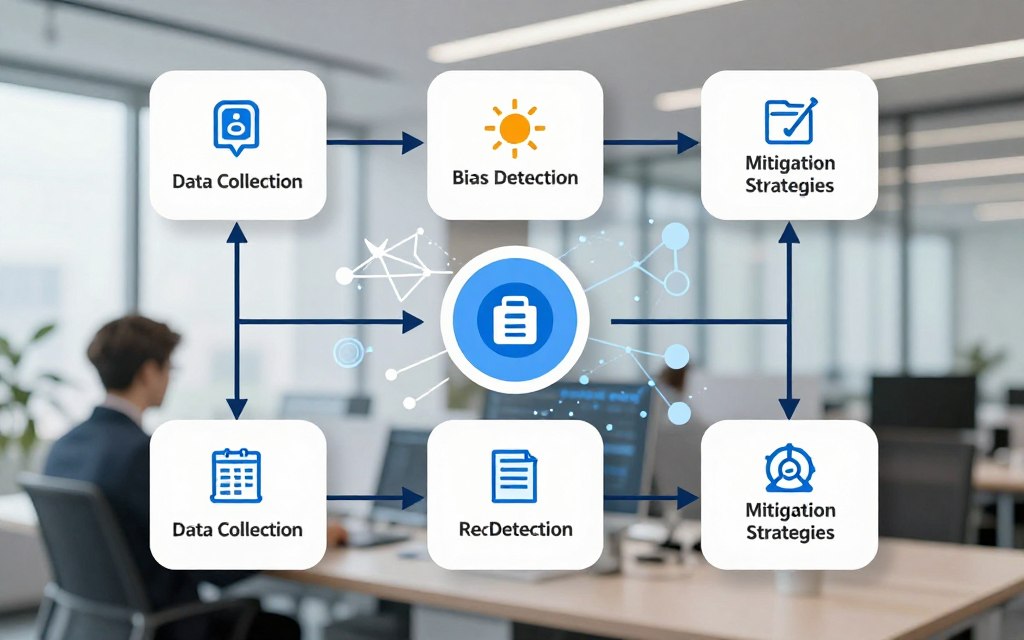
AI learns from data, and if that data is biased, so is the AI. This algorithmic bias can lead to unfair outcomes in many areas. To fix this, start with diverse training data.
Regular audits for bias are a must. Teams should check how models perform across different groups. Using fairness tools and debiasing can help make AI systems fair and just.
Upholding Data Privacy in an AI-Driven World
AI wants lots of data, but this clashes with our right to privacy. Data privacy AI is critical, with rules like the EU’s GDPR setting the standard.
Companies must design privacy into their systems. This means using less data, encrypting it well, and getting clear consent. Good data governance builds trust and protects personal info.
Towards Robust AI Governance and Regulation
The rules for AI are changing fast. AI regulatory compliance is now a key task. The EU’s AI Act, for example, classifies AI systems by risk and requires strict checks for high-risk ones.
“We are setting the standards for trustworthy AI globally, ensuring it respects our fundamental values and rights.”
In the US, the NIST AI Risk Management Framework offers guidelines. Companies that lead are setting up ethics boards and following AI principles that go beyond the law.
| Framework | Primary Scope | Key Requirements | Jurisdiction/Origin |
|---|---|---|---|
| EU AI Act | Risk-based AI system regulation | Conformity assessment, transparency, human oversight for high-risk AI | European Union |
| GDPR | Personal data protection | Lawful basis for processing, data minimisation, right to explanation | European Union (global impact) |
| NIST AI RMF | AI risk management | Governance, mapping, measuring, and managing AI risks | United States (voluntary) |
Good governance is key to making AI work for everyone. It turns good ideas into real practices, making AI a positive force.
Strategic Implementation and Overcoming Adoption Barriers
Having a clear AI vision is just the start. The real challenge is in the implementation phase. Many organisations face technical and human obstacles. Success requires understanding these challenges and having a clear plan.
Addressing Technical Integration and Cultural Hurdles
The journey to AI integration is not always easy. Common barriers can slow progress. Poor data quality is a major issue, affecting 68% of initiatives.
There’s also a skills gap in many teams. They lack the skills to work with AI. Integrating AI with old systems adds to the technical challenges.
Cultural resistance is another big hurdle. Employees might worry about losing their jobs or not understanding AI decisions. Using change management frameworks is key to overcoming this.
These barriers are linked. Technical issues can lead to cultural resistance. A skills gap can stop a project before it starts. Leaders must tackle these challenges together, not one after the other.
Building a Sustainable AI Strategy for Long-Term Success
Beating these challenges needs a solid, long-term AI implementation strategy. The aim is to build a lasting capability, not just a one-off project.
Begin with focused, high-ROI pilot projects. Pick use cases that solve real business problems and show quick results. This builds trust and prepares the ground for more investment.
A successful plan includes:
- Executive Sponsorship: Visible leadership support is essential for resources and adoption.
- Phased Roadmap: Roll out AI gradually. Learn from early pilots and then expand successful projects.
- Investment in People: Training the workforce is vital. Combine training with clear communication about AI’s role.
- ROI Focus: Set clear AI ROI goals from the start. This could be through efficiency, revenue, or customer satisfaction.
In the end, a sustainable strategy links all AI efforts to the company’s main goals. This ensures technology boosts competitiveness and turns initial pilots into a key part of long-term success.
Conclusion
Work and value are changing thanks to artificial intelligence. AI is transforming businesses, making them more competitive and innovative. It’s key for companies to adapt to this change to grow.
The best approach is to work together with AI. This means using technology to help humans make better decisions. It’s about more than just automating tasks.
Companies like IBM and Amazon show how AI can improve work. They use AI wisely and keep their teams up to date. This helps them stay ahead in a fast-changing world.
To succeed in the digital age, businesses need a clear plan. They should build flexible teams, have good leadership, and focus on working with AI. By doing this, they can stay strong and find new ways to serve customers better.
FAQ
What is the fundamental difference between Artificial Intelligence, Machine Learning, and Generative AI?
Artificial Intelligence (AI) is about making machines or software smart. Machine Learning (ML) is a part of AI where systems learn from data. Generative AI uses ML to create new content like text or images.
Is the primary goal of workplace AI to replace human employees?
No, AI’s main goal is to help humans work better. It automates simple tasks, freeing people to focus on more complex tasks. This way, AI helps humans be more creative and strategic.
How does AI actually improve human decision-making in business?
AI gives businesses better insights with data. It looks at lots of data to find patterns and predict trends. This helps in finance by making risk assessment and fraud detection more accurate.
In what ways is AI transforming the customer experience?
AI is changing how we interact with customers. It offers instant support through chatbots and personalises marketing. This makes customers happier and more loyal.
How is Generative AI affecting creative and professional roles?
Generative AI helps professionals by creating ideas and drafts. It doesn’t replace creativity but makes it faster. This lets designers and marketers focus on strategy and details.
What are the most important new skills needed to work effectively with AI?
New skills include understanding AI and how to work with it. You also need to think critically and solve problems. Being able to learn and adapt is key.
Will AI lead to widespread job losses?
AI will change jobs, not just eliminate them. It creates new roles like AI ethics officers. The focus is on adapting and learning new skills.
What are the biggest ethical risks associated with business AI adoption?
The main risks are bias and privacy. AI can be unfair if it’s trained on biased data. It’s also a security risk. Good governance and rules are essential.
What are the common barriers to implementing AI in a company, and how can they be overcome?
Barriers include technical issues and resistance to change. Success comes from a strategic plan. Start with a pilot, train employees, and align AI with business goals.


 By
By